Gauteng must ensure every rand derives tangible value and benefits for the people – MEC
3 December 2025
By Mandla Mpangase
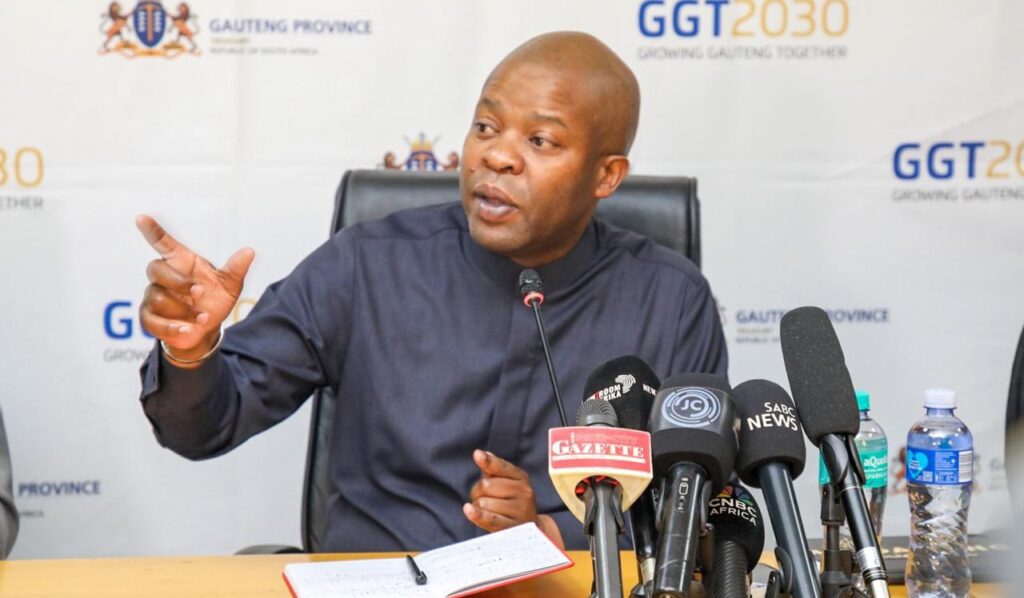
Infrastructure investment plays a pivotal role in economic development and job creation and contributes directly to the quality of life of our citizens, Gauteng MEC for Finance and Economic Development, Lebogang Maile, told the Gauteng Legislature during the tabling of the province’s medium-term policy statement and adjustment budget.
Addressing the Legislature on 2 December 2025 Maile said that Gauteng must increase its investment in infrastructure and improve on robust infrastructure systems that support all provincial services including transport, health, education and social development.
“The Provincial Treasury has already introduced various measures to improve on the efficient and effective use of financial resources allocated for infrastructure projects,” MEC Maile said, adding that Instruction Notes have been issued as promised with the aim of responding to the needs of the intended beneficiaries and to prevent wasteful expenditure.
“When we fail to deliver projects on time, within budget and to specifications inclusive of legislative compliance, we compromise on value for money.”
Funding constraints meant that the provincial government had to intensify its efforts to secure alternative resource financing models.
MEC Maile noted: “The high level of dependence on the provincial fiscus to fund infrastructure projects must also be addressed through the strengthening of cost recovery and exploring alternative funding sources.”
More focus was being placed on consequence management of poorly performing service providers. “All provincial departments and entities are encouraged to work with the Provincial Treasury and other relevant stakeholders to prepare bankable applications for infrastructure projects that qualify for Budget Infrastructure Fund funding.”
One key measure being taken was to focus on public-private partnerships as a vehicle to attract additional resources for infrastructure projects.
Maile pointed out that Gauteng’s economic output in 2024 reached R2.4-trillion, making the province the country’s economic hub, responsible for R33 out of every R100 the country’s economy produces.
Gauteng, with KwaZulu-Natal, and Western Cape, contributes approximately 63% of South Africa’s GDP.
“However, we understand that the economy of this province must record far higher growth rates to lift South Africa’s GDP, accelerate the creation of much needed jobs and reduce poverty,” Maile said.
Economic overview
It was against this backdrop that the provincial executive council recently approved the Gauteng City Region Economic Growth and Development Plan.
The plan is intended to contribute to the three strategic priorities of inclusive economic growth and job creation; improved living conditions and enhanced health and well-being; and a capable, ethical, and developmental state.
The strategy is anchored on 10 pillars:
- reindustrialisation through sector support;
- the promotion of trade and investment;
- spatial transformation and integration;
- economic and social infrastructure development;
- sustainable economic development;
- entrepreneurship and small business development support;
- skills of the future and workforce development;
- building state capacity;
- safety and security; and
- the development of corridors of regional integration.
The cross-cutting pillars of the strategy are innovation and digital transformation; women, youth and people with disabilities; township procurement; and research and development.
Gauteng City Region Economic Growth and Development Plan is also supported by 12 sector master plans to enable policies and strategies, including the Township Economy Development Act (and the Township Economy Revitalisation Strategy), the Informal Business Upliftment Strategy, the Medium, Small and Micro Enterprises Strategy, the Trade and Investment Strategy and Green Hydrogen.
MEC Maile told the Legislature that the Department of Economic Development is currently hosting several sector roundtables which will culminate in the establishment of the 12 sector-specific action labs.
“These action labs will act as multistakeholder collaborative and solution-oriented platforms to enhance the effectiveness and implementation of the strategy.
“The effective implementation of this strategy will set Gauteng on a positive economic growth path and create much needed jobs, amid global headwinds and domestic economic challenges,” Maile said.
“We are working in partnership with all key stakeholders to accelerate efforts to facilitate economic infrastructure development; trade and investment promotion; improve the ease of doing business; and empower micro, small and medium enterprises, particularly those owned by previously disadvantaged groups.”
This will go a long way in enabling the province to close the current output gap, enhance production and significantly increase our participation in international markets, he explained.
The MEC tabled the Medium-Term Budget Policy Statement 2025, the Adjusted Estimates of Provincial Revenue and Expenditure 2025, and the Adjusted Estimates of Capital Expenditure 2025 for consideration.
A responsible balance
“The national fiscal framework is aimed at ensuring a responsible balance between government spending, tax revenue, and borrowing to prevent unsustainable debt to create a stable environment for long-term growth, job creation and investment financing of public services,” Maile said.
“As the provincial government, our fiscal trajectory reflects these national issues. That is why our focus is on debt management, revenue strategies, and spending restraint, while seeking alternative funding sources to meet increasing public service demands amidst weak economic performance.”
The provincial five-year budget approach introduced in the previous financial year will be continued for the 2026 Medium-Term Expenditure Framework (MTEF) Budget with the aim of addressing high-level provincial risks and stabilising public finances.
The principles guiding the 2026 MTEF Budget include:
- Protecting vulnerable members of our society;
- Realising efficiencies in the provincial procurement processes;
- Focusing on “ready-to-deliver” infrastructure projects;
- Funding accruals as a first charge against the department’s budget allocation;
- Reprioritising existing baselines to fund provincial priorities budget pressures or new funding requirements;
- Compensation of Employees budgets must remain within the limits set in the 2025 Budget; and
- Ensuring long-term fiscal sustainability through own revenue collection, alternative funding sources, trade-offs, downscaling or stopping programmes.
“The goal of these principles is to stabilise provincial public finances by maintaining fiscal discipline and credibility and ensure impactful service delivery.”
Adjustments budget
The 2025/26 Adjustments Budget addresses pressures in frontline services, as a means of equipping the Gauteng Provincial Government to continue responding to the provincial imperatives underpinning the 2024 – 2029 MTDP and the G13 priorities.
The total adjustment is R3.3-billion which includes the rollovers, national and provincial funding. As part of this Adjustments Budget, an additional R2.2-billion has been allocated to provincial departments as follows:
- The Office of the Premier will receive an additional amount of R43.9-million, of which R40.8-million goes towards honouring outstanding claims from the Life Esidimeni mental health users project, and R2.8-million for the filling of critical posts.
- The Department of Health is allocated R1.1-billion towards offsetting the pressures in the goods and services baseline, and a further R90-million towards its infrastructure programme.
- The Department of Education will receive R507.8-million, of which R200-million is to alleviate pressures in the compensation of employees line item, and the balance to scholar transport, school 12 nutrition and school safety, which are key goods and services cost drivers.
- The Department of Social Development is allocated R103.9-million, of which R35.5-million is for augmenting the infrastructure programme allocation and the balance towards goods and services items exhibiting pressures.
- The Department of Community Safety is allocated R92.6-million to alleviate pressures facing various items under goods and services.
- The Department of Sport, Arts, Culture and Recreation will receive R10-million, of which R6-million is towards the Summer Games that will be taking place in December 2025. A total of R3-million will be allocated towards goods and services, and R1-million for the compensation of employees.
- A total of R400-million is allocated to eGovernment of which R200-million is to address the looming obsolescence of equipment for the Gauteng Provincial Network, and the balance of R200-million towards offsetting pressing commitments under goods and services.
- The Department of Infrastructure Development is allocated R2-million to alleviate pressures in goods and services, and R13-million for the compensation of employees.
“As we have said before, we are operating in a difficult environment in which we must find ways to strike a balance between the growing demand for public services and the fiscally constrained economy. We are addressing Gauteng’s fiscal trajectory through a combination of active debt management strategies and spending restraint.”
The MEC also used the occasion to launch the pilot phase of TendaSwift – the province’s new e-procurement platform that will automate and digitise the entire tender management process in the province.
Reiterating the message of Finance Minister Enoch Godongwana during his medium-term budget policy statement speech, Maile concluded: “‘We are choosing growth, stability, and reform’. I would like to affirm that as the Gauteng Provincial Government, we remain singularly focused on protecting social services, supporting inclusive growth, and ensuring that every rand derives tangible value and benefits to the people of Gauteng.”